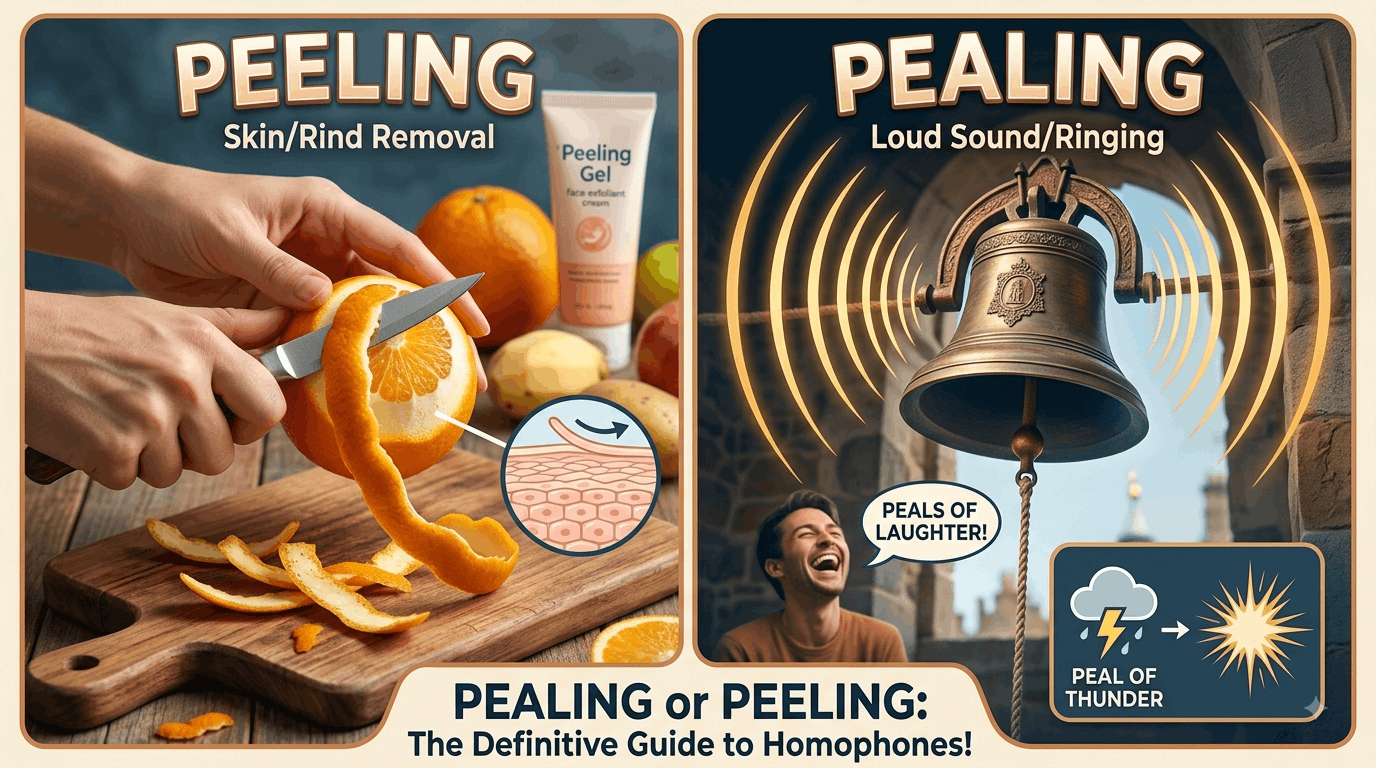
Pealing or Peeling: The Definitive Guide to Homophones, Etymology, and Correct Usage
English vocabulary contains numerous homophones—words that sound identical when spoken aloud but feature distinct spellings, origins, and meanings. Among the most frequently confused pairs in both everyday writing and digital content is pealing or peeling.
Because “peal” and “peel” sound exactly the same, writers often struggle to decide whether an object is peeling off or a sound is pealing through the air. Misusing these terms can weaken the clarity of your content, undermine professional communication, and affect search engine visibility when targeting specific query intents.
This comprehensive guide breaks down the core definitions, etymologies, grammatical applications, domain-specific contexts, and memory devices necessary to distinguish between pealing or peeling with total accuracy.
Executive Summary & Quick Reference
If you need an immediate answer to whether you should use pealing or peeling, consult this quick-reference comparison.
| Metric / Aspect | Peeling (PEEL) | Pealing (PEAL) |
| Primary Meaning | Removing an outer layer, skin, rind, or coating; stripping away. | Resounding loud sounds, especially ringing bells, thunder, or bursts of laughter. |
| Base Form | Verb: Peel | Noun: Peel | Verb: Peal | Noun: Peal |
| Etymology | Old French peler / Latin pilare (to strip hair/skin). | Shortened from appeal (Anglo-French apel, a legal or religious call). |
| Common Contexts | Skincare (chemical exfoliation), cooking (peeling fruit), industrial paint, sunburns. | Campanology (church bells), weather reports (peals of thunder), acoustic events. |
| Example Sentence | “Her skin was peeling off after a long day in the hot summer sun.” | “A sudden peal of laughter echoed down the empty corridor.” |
Key Takeaway: If the context relates to physical surface removal, skin, or food prep, the correct spelling is always peeling. If the context relates to loud sound, music, ringing, or noise, the correct spelling is always pealing.
Etymology and Historical Development
Understanding where a word comes from provides the strongest foundation for remembering how to spell and apply it correctly.
Latin: pilare (to strip of hair/skin)  ──►  Old French: peler  ──►  English: PEEL (14th Century)
Anglo-French: apel (a legal/formal call) ──► Middle English: pele ──► English: PEAL (14th Century)
The Origins of “Peel”
The word peel entered Middle English around the late 14th century via the Old French verb peler (“to strip, skin, or peel”), which derived directly from the Latin pilare (“to strip off hair”) and pellis (“skin” or “hide”).
Historically, to peel meant stripping away the protective exterior of an object—whether that meant skinning an animal, stripping bark from a tree, or paring the rind from fruit. Over centuries, the scope expanded to include synthetic surfaces, such as peeling paint, industrial adhesives, and dermatological treatments like a chemical exfoliation peel.
The Origins of “Peal”
The word peal developed through a completely separate linguistic pathway. It emerged in Middle English as an aphetic (shortened) form of the Anglo-French word apel (or appeal).
In legal and religious traditions of the Middle Ages, an appeal was a formal summons or call to action. When applied to church bells, an “appeal” referred to the loud, structured ringing meant to summon townspeople to prayer or civic gatherings. Over time, the initial “a” dropped off, leaving the noun and verb peal to designate any sustained, loud reverberation of sound.
Comprehensive Breakdown of “Peel”
The term peel operates across multiple parts of speech, serving as a transitive verb, an intransitive verb, and a noun.
Verb Definitions & Conjugations
To peel means to strip away the skin, outer layer, rind, or covering of something.
- Base Form: Peel (e.g., “I need to peel this apple.”)
- Third-Person Singular: Peels (e.g., “The old paint peels off in humid weather.”)
- Past Tense: Peeled (e.g., “He peeled off his wet socks.”)
- Present Participle: Peeling (e.g., “The wallpaper is peeling away from the wall.”)
Noun Formats
As a noun, a peel refers to:
- The outer skin or rind of a fruit or vegetable (e.g., “an orange peel“).
- A long-handled wooden or metal shovel tool used by bakers to slide bread or pizza into an oven (a baker’s peel).
- A dermatological treatment applied to resurface skin (e.g., an exfoliating peel).
   [ Physical Layers ] ──────► "Peeling" ──────► Stripping / Skin Removal
   [ Baking Tool ]     ──────► "Peel"    ──────► Pizza/Bread Paddle
Common Idioms and Phrases Using “Peel”
- Keep your eyes peeled: To remain vigilant, watch carefully, or stay alert (never written as eyes pealed).
- Peel out: Slang meaning to accelerate a motor vehicle rapidly, leaving tire rubber on the road.
- Peel off: To separate from a group or formation (e.g., “The jet aircraft peeled off from the squadron”).
Comprehensive Breakdown of “Peal”
While less common in modern conversational vocabulary than its homophone, peal remains essential in literature, acoustics, and formal writing.
Verb Definitions & Conjugations
To peal means to sound loudly, ring out continuously, or chime with reverberating force.
- Base Form: Peal (e.g., “Listen to the cathedral bells peal across the square.”)
- Third-Person Singular: Peals (e.g., “Thunder peals in the distance.”)
- Past Tense: Pealed (e.g., “Laughter pealed through the auditorium.”)
- Present Participle: Pealing (e.g., “The pealing bells announced the festival.”)
Noun Formats
As a noun, a peal describes a loud, prolonged burst of sound, or a specific set of tuned bells.
- Acoustic Burst: A peal of laughter, a peal of thunder, or a peal of applause.
- Campanology (Bell Ringing): A set of bells tuned to a musical scale, or a specific sequence of change ringing (e.g., “a peal of bells“).
Domain-Specific Contexts for “Peeling”
Because peeling covers physical separation and surface removal, it appears heavily across distinct industries and daily applications.
1. Skincare, Dermatology, and Exfoliation
In aesthetics and dermatology, peeling refers to the shed or removal of dead epidermal cells.
- Chemical Exfoliation Peel: A cosmetic treatment where an acid solution (such as alpha-hydroxy acid or beta-hydroxy acid) is applied to dissolve intercellular glue, causing the top layer of skin to slough off.
- Exfoliating Peel Products: Formulations designed to remove surface debris. Terms like peeling exfoliant, exfoliating face peel, and peeling skin exfoliate describe products that promote cell turnover.
- Sun Damage: When skin undergoes UV damage, damaged skin cells slough off in sheets—a phenomenon known as peeling off.
[ Chemical Solution ] ──► Dissolves Cellular Bonds ──► Controlled "Peeling" ──► Smooth Skin
2. Culinary Arts & Food Preparation
In professional kitchens and home cooking:
- Chefs use a paring knife or vegetable peeler to peel potatoes, citrus fruit, or squash.
- Citrus zest comes from the outer peel, excluding the bitter white pith beneath.
3. Industrial Coatings, Manufacturing, and Material Science
In industrial manufacturing and construction:
- Peel Strength: A key measurement in adhesive bonding evaluating the force required to separate bonded materials.
- Peelable Coatings: Protective films applied to manufactured goods that remain intact during shipping and are peeled off prior to end-user installation.
- Surface Failure: Paint or sealant flaking off due to moisture intrusion is described as peeling paint.
Domain-Specific Contexts for “Pealing”
The application of pealing is heavily focused on sound waves, musical acoustics, and literary imagery.
1. Campanology (The Art of Bell Ringing)
In campanology, pealing carries a technical definition beyond simple noise:
- A full peal consists of a specific performance of change ringing containing at least 5,040 precise permutations on eight or more bells, typically lasting over three hours.
- The physical motion and sound of large bronze bells swinging in a tower are described as pealing bells.
2. Meteorology and Atmospheric Phenomena
Atmospheric disturbances that create sustained sonic booms are written using “peal”:
- A peal of thunder refers to the deep rumble that follows a lightning flash, caused by the rapid expansion of heated air columns.
3. Literary Metaphor and Human Expression
In narrative writing, vocal emotional expressions are often paired with “peal”:
- Peals of laughter: Sudden, loud bursts of uncontrollable mirating sound from a crowd or individual.
- Peals of joy / shouts: Ringing vocalization expressing celebratory emotion.
Direct Comparative Analysis: Pealing vs. Peeling
To prevent confusion, review how identical phonetic sounds convert into distinct written representations based on sentence intent.
   SOUND EVENT        ──►  P-E-A-L  ──►  "Pealing thunder", "Peal of bells"
   SURFACE LAYER      ──►  P-E-E-L  ──►  "Peeling skin", "Peel an apple"
Side-by-Side Sentence Mapping
| Incorrect Form | Correct Form | Why It Change Matters |
| The church bells were peeling all morning. | The church bells were pealing all morning. | Bells emit sound (peal); they do not shed physical skin (peel). |
| Keep your eyes pealed for road signs. | Keep your eyes peeled for road signs. | Metaphorically opening your eyelids wider relates to peeling back layers. |
| He heard a peel of thunder. | He heard a peal of thunder. | Thunder is an acoustic phenomenon (peal). |
| Apply a chemical peal to brighten skin. | Apply a chemical peel to brighten skin. | Skincare treatments strip epidermal layers (peel). |
Acronyms & Specialized Structures: P.E.E.L. vs. P.E.A.L.
In educational pedagogy and analytical writing, P.E.E.L. is a widely taught paragraph structure designed to help students construct persuasive essays.
P ──► Point      (State your main claim clearly)
E ──► Evidence   (Support your claim with facts, quotes, or data)
E ──► Explain    (Analyze how the evidence proves your point)
L ──► Link       (Connect back to the overall thesis or next paragraph)
What is the P.E.E.L. Paragraph Method?
- P – Point: Introduce the core argument of the paragraph in a single opening sentence.
- E – Evidence: Provide concrete facts, citations, research, or textual examples backing up the claim.
- E – Explanation: Unpack the evidence, analyzing why and how it supports the main argument.
- L – Link: Connect the conclusion of the paragraph back to the overarching topic or transition into the subsequent point.
Note on Spelling: Because P.E.E.L. stands for Point, Evidence, Explanation, Link, writing P.E.A.L. in an educational context is grammatically incorrect unless used as an acronym created for a separate specialized discipline.
Memory Tricks & Mnemonics
To ensure you never misuse pealing or peeling in your writing, use these simple association devices:
P [ E E ] L  ──►  P [ E ] xfoliate  [ E ] pidermis  (Skin & Layers)
P [ A ] L    ──►  P [ A ] coustic   [ A ] udible     (Sounds & Bells)
- The Double “E” Rule:
- PEEL contains two Es. Think of Exfoliation and Epidermis. If it relates to surface layers or skin, use the double E.
- The Letter “A” Rule:
- PEAL contains the letter A. Think of Acoustics, Audible, or Applaus. If you can hear the sound with your ears, choose peal.
- The Bell Association:
- A church bell is shaped like an A frame. Therefore, a bell gives off a peal.
Frequently Asked Questions (FAQs)
Is it “eyes peeled” or “eyes pealed”?
The correct phrase is “keep your eyes peeled.” This idiom originates from the idea of peeling back your eyelids to look intently or keep watch. Writing “eyes pealed” is a homophone error.
What does “pealed” mean compared to “peeled”?
Pealed (with an a) means rang out loudly or resounded (e.g., “The thunder pealed across the sky”). Peeled (with an e) means stripped away an outer layer or moved away (e.g., “She peeled the banana”).
Can a bell be “peeling”?
Literally, no. A bell produces sound, so it is pealing. The only time a bell could be “peeling” is if paint or metallic plating were physical flaking off its outer surface.
What is a chemical exfoliation peel?
A chemical exfoliation peel is a skin-resurfacing procedure that applies a chemical solution to remove the top layers of dead skin, leaving behind smoother, refreshed skin underneath.